Lawn Care 2026
A Simple Summary:
- Mow at 3″ to 4″ at least weekly.
- Apply fertilizer around the major holidays according to the bag instructions
- Spot spray weeds as needed using a labeled lawn herbicide
If you only do these three things, your lawn will likely look better than most.
How I Approach My Lawn
I keep things simple and consistent throughout the season. I use a handful of holidays: Easter, Memorial Day, Independence Day, Labor Day, and Halloween as general reminders for when to fertilize and check weed pressure. They are not strict dates but easy anchors that keep me on track.
Everything else is adjusted based on conditions. If the lawn is growing fast I mow more often. If it slows down due to heat or drought I back off. The same idea applies to spraying for herbicides. I do not apply anything if there are no weeds present or if conditions are not right, especially during heat stress.
I rarely use sprinklers but will if the lawn is looking extra unwell such as prolonged heat and/or droughts.
Weekly Mowings
My mowing height stays at 3 inches, and I mulch clippings back into the lawn rather than bag them. This keeps things simple and helps return nutrients to the soil.
I alternate mowing directions (north–south and east–west when practical) to reduce ruts and keep the turf standing upright. I also edge along the driveway and sidewalks to maintain a cleaner, more defined appearance.
The one thing I should be doing better is sharpening my blade on a regular schedule—ideally around each holiday—but I never claimed to be perfect.
Fertilizer Program
For fertilizer, I aim for a moderate and consistent approach. I apply around 0.80 pounds of nitrogen per 1,000 square feet per application using 40-0-5 fertilizer. In practice, that comes out to about 10 pounds of product per application across my 5,000 square foot lawn. My spreader setting is 3.5 but I adjust slightly when using a different fertilizer product.
A typical fertilizer application for my lawn looks like this:
- 40-0-5 fertilizer: 10 lbs total per application (covers 5,000 sq ft)
- Spreader setting: 3.5
- Application rate target: 0.80 lbs nitrogen per 1,000 sq ft
- Fill pattern: broadcast evenly across entire lawn in a single pass
The goal is not to push extreme growth. It is steady healthy turf without stressing the lawn or forcing excessive mowing.
Weed and Insect Control
My weed and insect applications are built around a backpack sprayer setup. All of my rates are calculated per 1,000 square feet and I mix them into roughly 4 gallons of water which is my carrier volume for coverage and not tied directly to the rates themselves.
The following rates are the actual quantities I use on my 5,000 sq ft lawn and are included primarily as a reference for my own records. Always calculate and verify rates based on the specific product label being used and your own lawn size.
- 4 Gallon Electric Backpack Sprayer with a TeeJet Nozzle
- 3 way herbicide (2,4-D 30.9%, MCPA 8.23%, Dicamba 2.77%): 5.5 oz
- Quinclorac (18.92%): 7.5 oz
- Triclopyr (61.6%): 2.5 oz
- Non ionic surfactant: 1 oz
- Bifenthrin (7.9%): 2.5 oz
- Fill tank full to approximately 4.5 gallons total spray volume
For general broadleaf weeds like dandelions, clover, and plantain, I rely on the 3 way herbicide. I use quinclorac when crabgrass or other grassy weeds show up. For tougher perennial weeds like creeping Charlie or wild violet, I use triclopyr.
I typically include a non ionic surfactant with herbicide applications to improve coverage and adhesion. Although I have used methylated seed oil in the past, I prefer NIS because it is generally less stressful on turf in routine lawn applications.
For insect control, I use bifenthrin, which works great against the ticks, mosquitos, and earwigs that I primarily target.
To prevent damage to your turf or limitations on seeding, be sure to follow all label directions and application restrictions, including temperature limits and reseeding intervals.
Non Turf Areas
For non turf areas like rock beds, fence lines, and driveways, I use a separate setup with a one gallon pump sprayer. These applications are strictly for total vegetation control where complete kill is the goal.
A typical spot treatment mix looks like this:
- 1 Gallon Pump Sprayer
- Glyphosate (41%): 3 oz per 1 gallon water
- Methylated seed oil (MSO): 1 oz per 1 gallon
- Spray volume: 1 gallon pump sprayer applied to target areas only
This is used only in non turf areas where permanent vegetation removal is desired.
Over/Reseeding
I do not overseed very often because the rest of my lawn care routine generally keeps the turf thick and healthy. When I do need to repair thin areas or reseed, I keep the process simple.
I start by mowing the area short and removing any dead grass, debris, or thatch with a metal rake. Once the surface is cleared, I lightly loosen the soil and apply seed at the recommended rate listed on the bag using my broadcast spreader. I then rake the area again to work the seed into the loosened soil. Most of the time I will grab compost from the city site to provide better seed to soil contact as well as to get the soil a boost in organic matter. After seeding, I lightly compact the area by walking over it to ensure good seed-to-soil contact, which is critical for germination.
Watering is the most important part of the process. I use a sprinkler connected to a garden hose on a timer and first determine how long the area can be watered before runoff or pooling begins. I then set the watering duration slightly below that threshold.
For the first couple of weeks, I water frequently enough to keep the seedbed consistently moist, typically three times per day at 6:00 AM, 12:00 PM, and 6:00 PM. If I am seeding slower-germinating varieties such as Kentucky bluegrass, I may continue that schedule for an additional week. Once germination is well underway, I reduce watering to once per day in the morning for another couple of weeks before transitioning back to being on Mother Nature’s schedule.
Soil Testing
When I take a soil test, I focus on consistency more than anything. I pull 10–15 small cores across the lawn in a zig-zag pattern, avoiding obvious problem areas like burn spots and edges near pavement where runoff can skew results. Each sample is taken about 3–4 inches deep with surface thatch removed, then mixed into one composite sample to represent the yard as a whole.
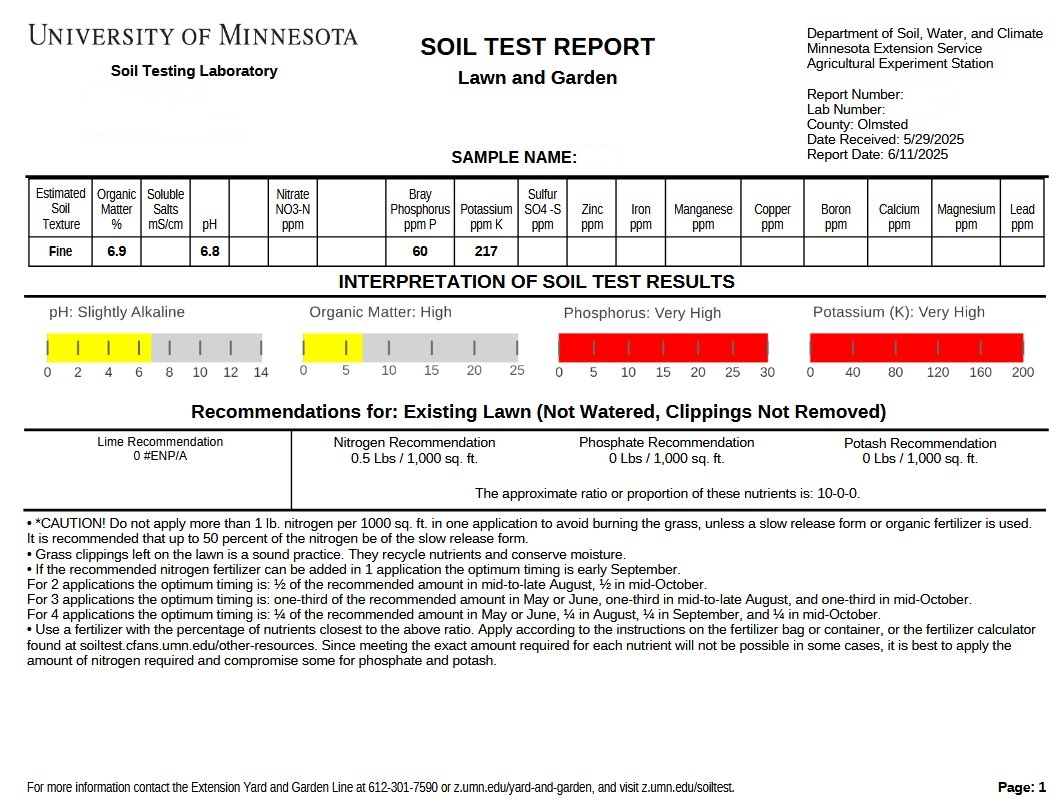
My most recent test came back with a fine soil texture, 6.9% organic matter, pH of 6.8, phosphorus at 60, and potassium at 217. In practical terms, this is a well-balanced soil for a cool-season lawn, especially with pH in a strong range and both phosphorus and potassium already sufficient. The takeaway is simple: nitrogen is really the only nutrient I need to actively manage for growth and color, while everything else is monitored and only adjusted if future tests show a need.
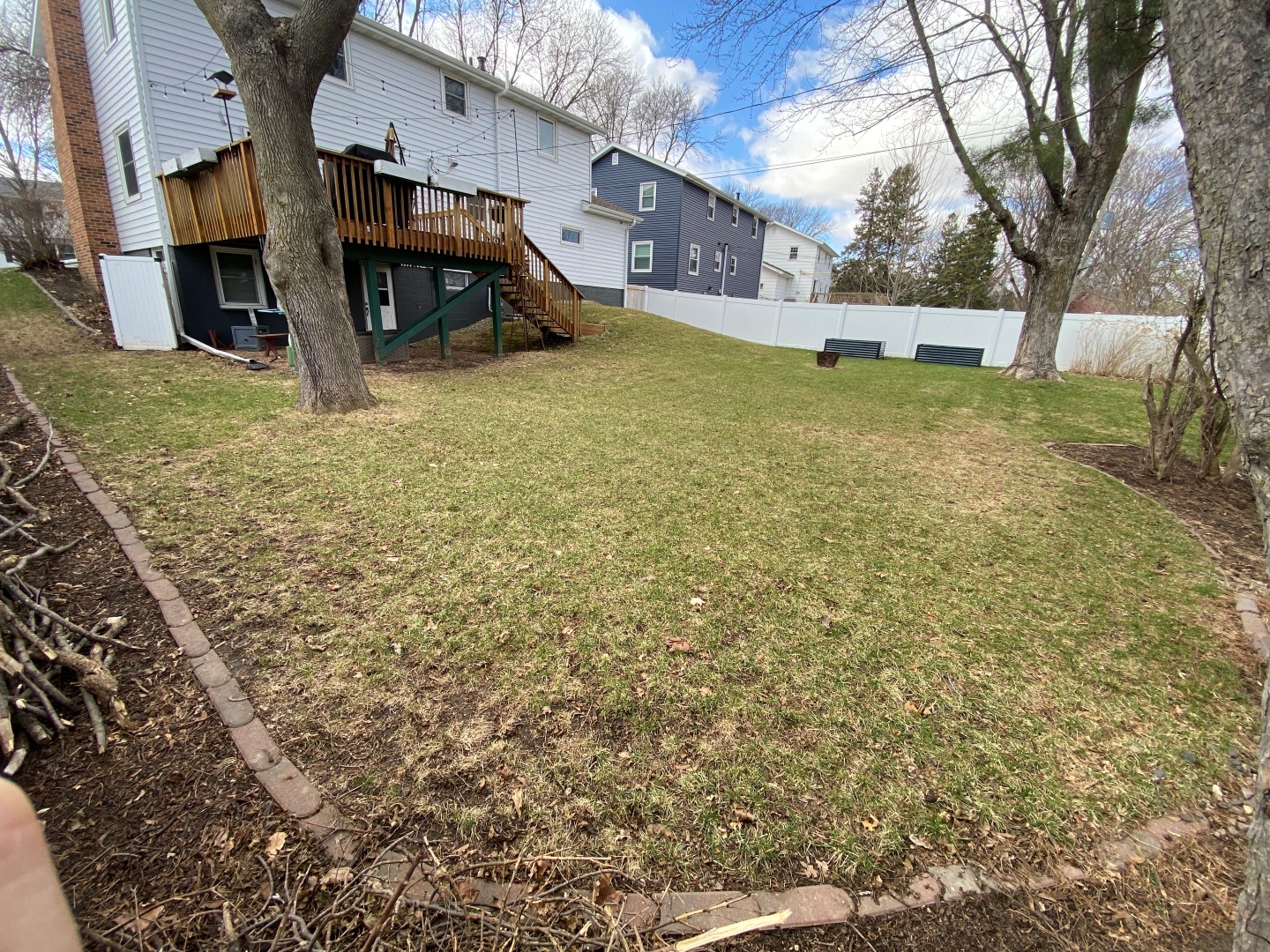
Easter
(Early Spring)
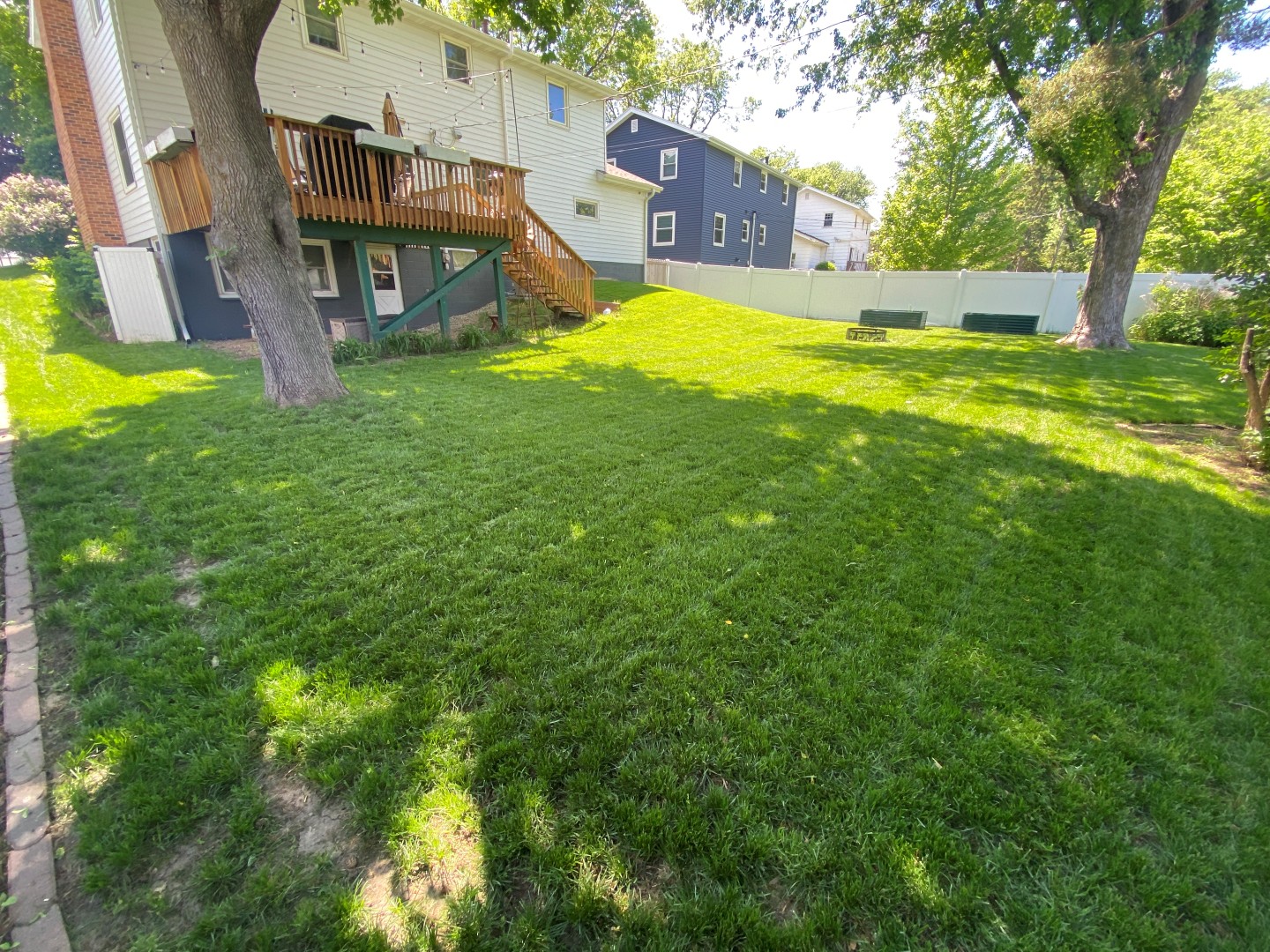
Memorial Day
(Late Spring)

Independence Day
(Mid Summer)

Labor Day
(Early Fall)

Halloween
(Late Fall)
Lawn Care 2025
Weekly (Every 5 to 7 Days)
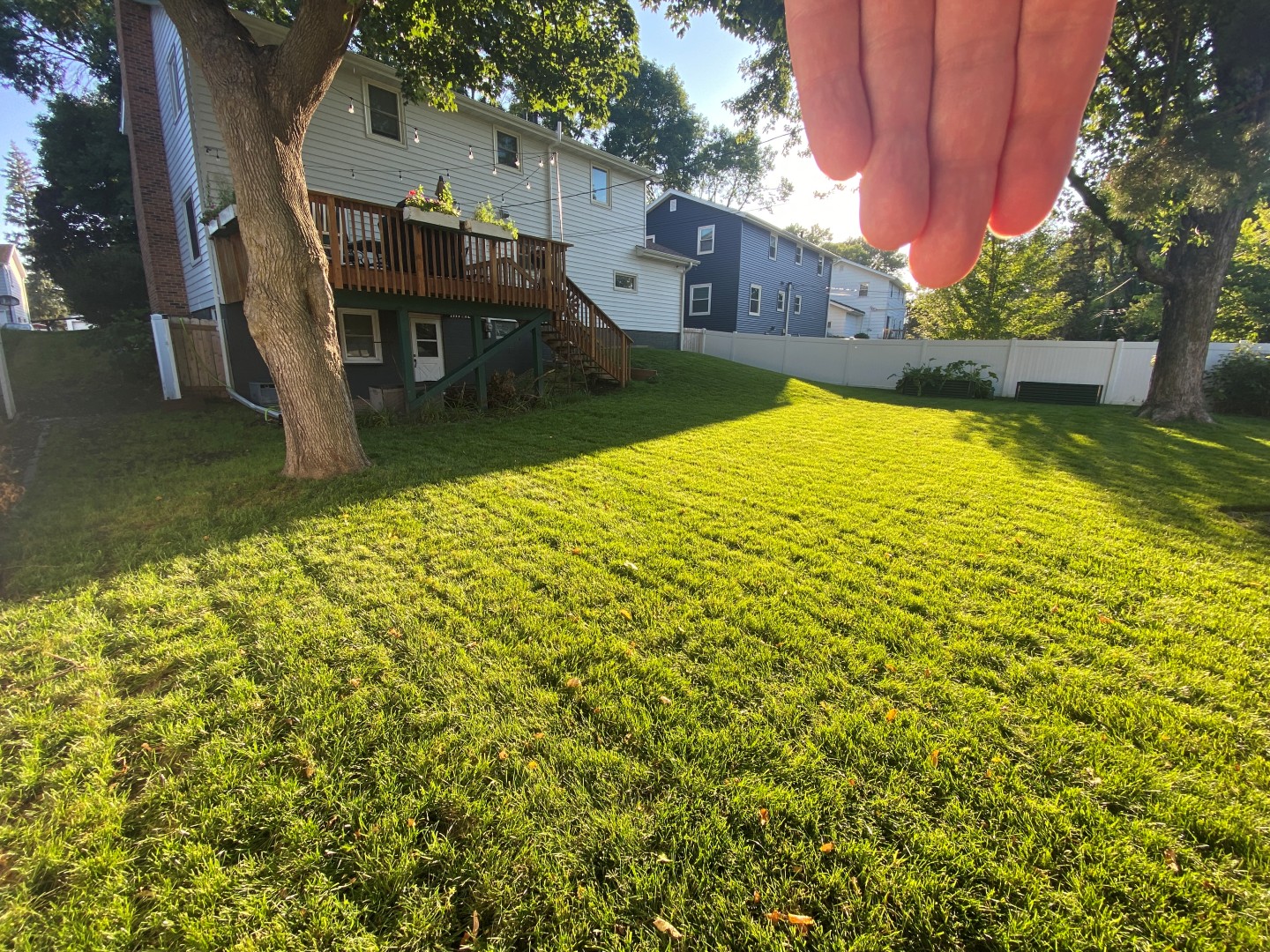
- Mow at 3 1/2″
- Edge borders
- Leaf blow driveway and sidewalk
As Necessary
- Apply insecticide to yard and foundation
- Apply fungicide
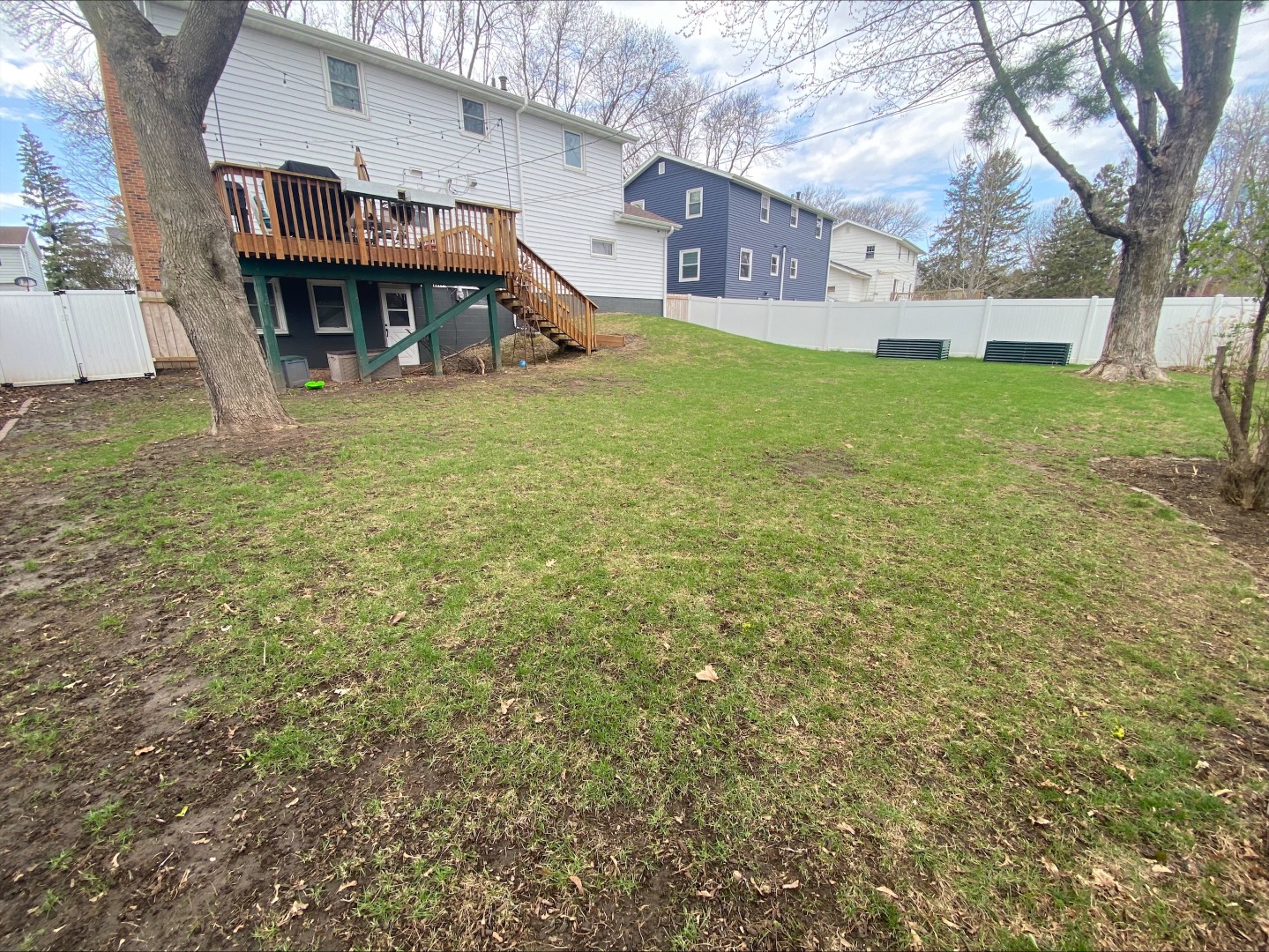
Early Spring (Easter)
- 4/11 – Dethatched lawn
- 4/13 – Overseeded at 2.5lbs/1,000 sq ft
- 4/13 – Fertilized (#5 – 1.22lbs n/k)
- 5/3 – Sprayed for weeds
- 5/6 – Mowed & edged
- 5/13 – Mowed & edged, sprayed insecticide
- 5/16 – Mowed & edged
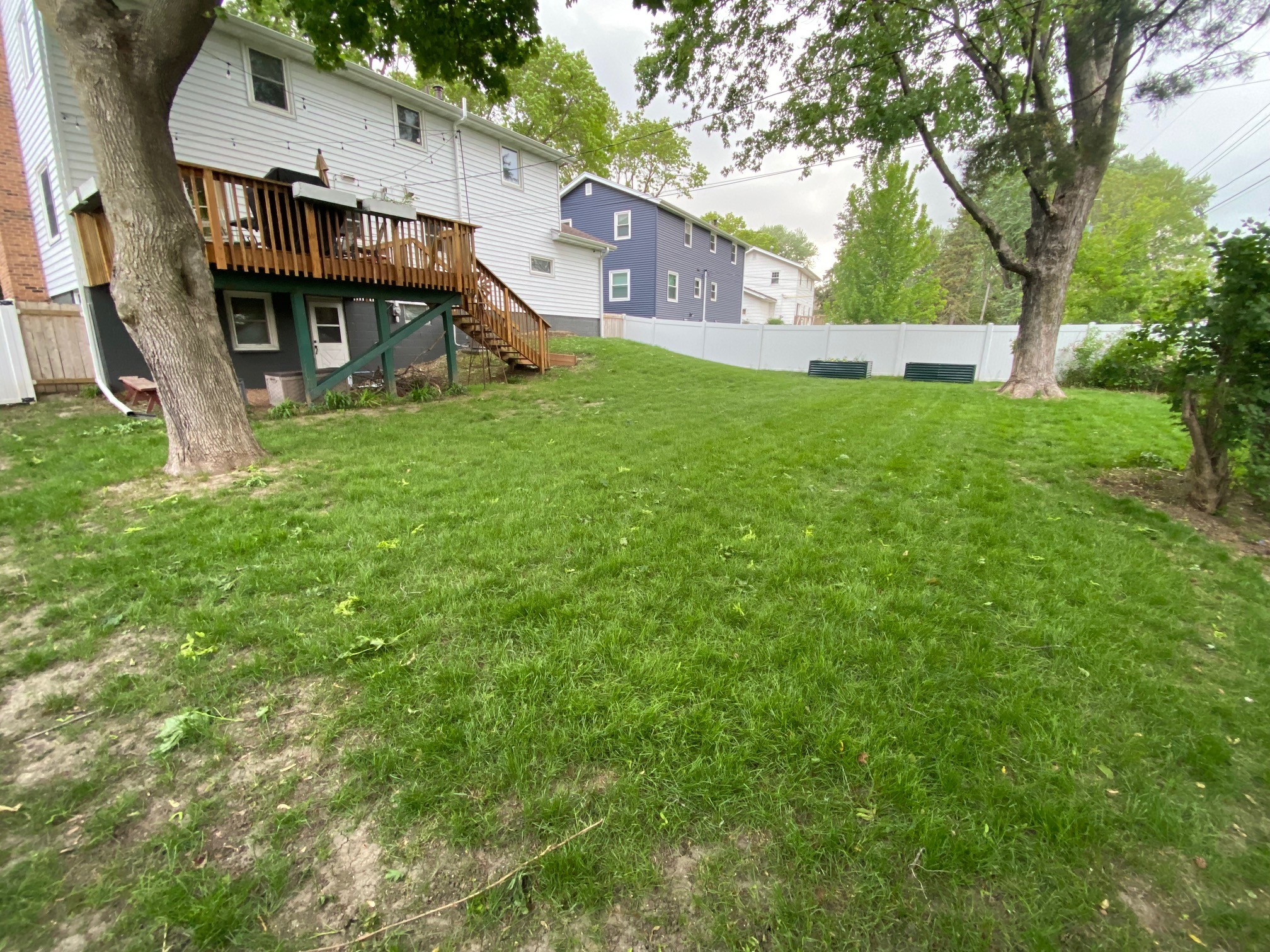
Late Spring (Memorial Day)
- 5/19 – Fertilized (#5 – 1.22lbs n/k)
- 5/22 – Mowed & edged
- 5/25 – Sprayed vegetation killer into rock & mulch gardens
- 5/26 – Soil sample collected
- 5/29 – Mowed & Edged, sprayed for weeds
- 6/5 – Mowed & edged
- 6/11 – Mowed & edged, sprayed vegetation killer into driveway and sidewalk cracks. Received SOIL TEST results
- 6/13 – Sprayed fungicide
- 6/18 – Mowed & edged
- 6/24 – Mowed & edged
- 6/29 – Mowed & edged
- 7/1 – Sprayed insecticide
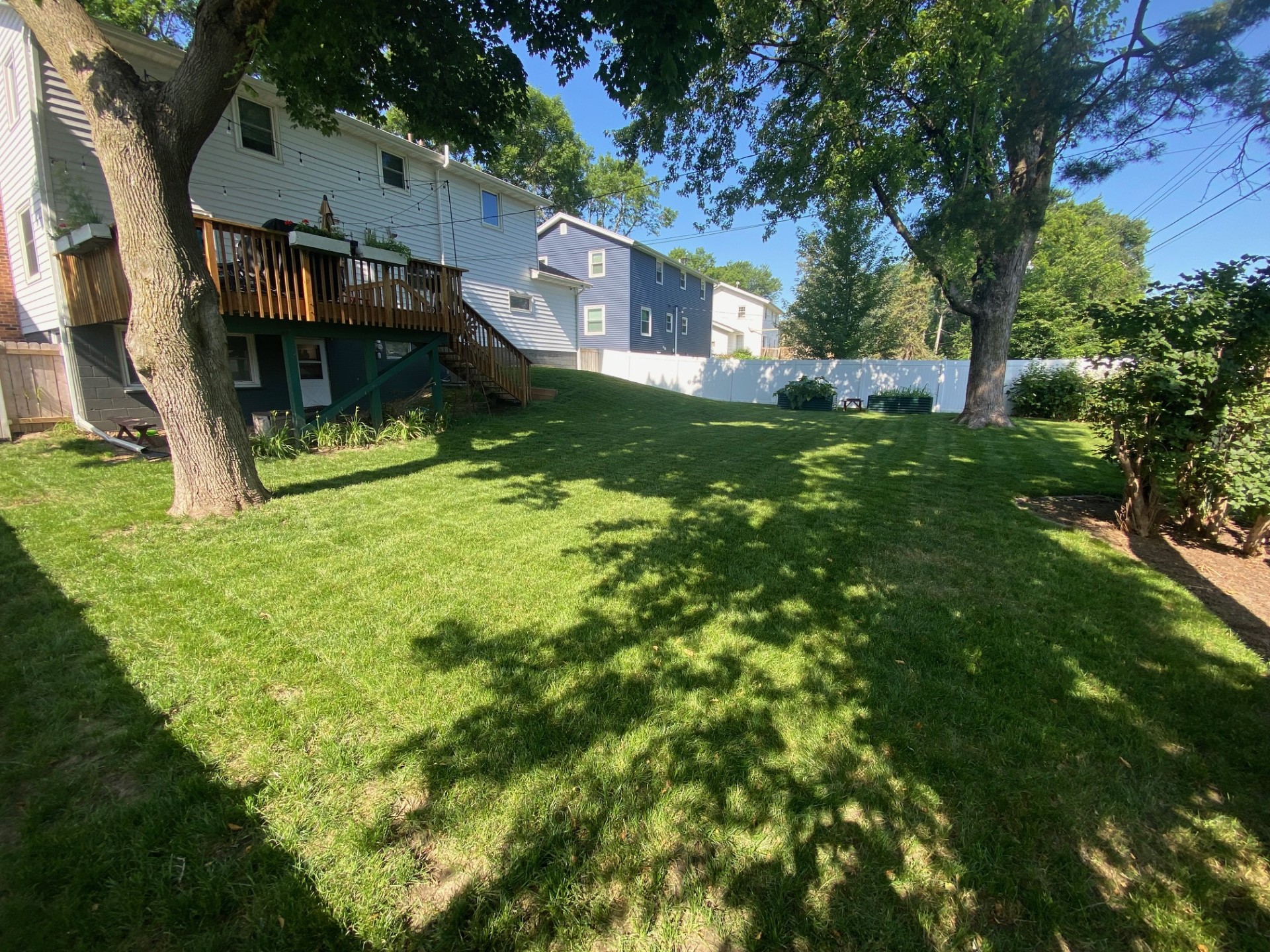
Independence Day (Mid Summer)
- 7/4 – Fertilized (#3 – 0.38lbs n/k)
- 7/4 Mowed & edged
- 7/9 Mowed & edged
- 7/17 Mowed & edged
- 7/23 Mowed & edged
- 7/27 Mowed & edged
- 8/2 Mowed & edged
- 8/6 Mowed & edged
- 8/12 Mowed & edged
- 8/17 Mowed & edged
- 8/23 Mowed & edged, fertilized at .80lbs Nitrogen/1,000 sq ft (#4), sprayed for weeds, sprayed for bugs.
Labor Day (Early Fall)
- Labor Day task happened a week early due to being out of town Labor Day weekend.
- 8/28 Mowed & edged
- 9/2 Mowed & edged
- 9/7 Mowed & edged
- 9/12 Mowed & edged
- 9/17 Mowed & edged
- 9/22 Mowed & edged
- 9/27 Mowed & edged
- 10/2 Mowed & edged
- 10/7 Mowed & edged
- 10/12 Mowed & edged
- 10/17 Mowed & edged
- 10/22 Mowed & edged
- 10/ 27 Mowed & edged
Halloween (Late Fall)
- Final Mow at 2″ & Edge, Fertilize and Spray for Weeds
- Mow as necessary to mulch leaves
Hardware List & Application Rates
All rates listed are per 1,000 sq ft. It is CRITICAL that you know how many sq ft your lawn is before applying any chemicals to it. At best, they will be ineffective. At worst, you will kill your lawn.
Grass Seed & Fertilizer
- ECHO 60 lbs. Heavy-Duty Spreader
- 1lb Twin City Seed Tuff Turf Lawn Seed Mixture
- I have not used this specific product yet but plan to when my current seed runs out.
- 2.08 lbs (0.50 lbs nitrogen) 50 lb Lesco 24-0-11 Fertilizer
- I have not used this specific product yet but plan to when my current fertilizer runs out.
Herbicide
- Spraymate Tornado 4 Gal Backpack Sprayer
- TeeJet XR11004VS
- 1.5 oz Ike’s Concentrate Lawn Weed Killer (1 Gal)
- 1.45 oz Drive XLR8 (64 oz)
- 0.75 oz AlliGare Triclopyr (32 oz)
- 1 oz (Per Gal) Southern Ag Methylated Seed Oil (MSO) Surfactant (32 oz)
Insecticide
- Spraymate Tornado 4 Gal Backpack Sprayer
- TeeJet XR11004VS
- 1 oz Talak 7.9% Bifenthrin Concentrate (32 oz)
Non-Selective Herbicide (Per Gallon)
- Chapin 20000 1 Gal Sprayer
- 1.5 oz Compare-N-Save Concentrate Glyphosate Grass & Weed Killer (32 oz)
- 1 oz Southern Ag Methylated Seed Oil (MSO) Surfactant (32 oz)
Fungicide
- Spraymate Tornado 4 Gal Backpack Sprayer
- TeeJet XR11004VS
- 2 oz Propiconazole (32 oz)
- 1 oz Southern Ag Methylated Seed Oil (MSO) Surfactant (32 oz)
Watering (Overseed Only)
- Melnor 65167AMZ XT Turbo Oscillating Sprinkler
- Flexzilla Garden Hose 3/4 in. x 50 ft
- Twice daily – 10 minutes per zone
Dethatching/Scarifying
- Sun Joe Electric Lawn Dethatcher & Scarifier (13″)
- Southwire 12/3 Outdoor Extension Cord (100 FT)
- Some old corded leaf blower
- Sun Joe w/Scarifying blade set to -10 mm
- Scarify N to S as well as E to W
- Leaf blow into pile for compost or disposal
Lawn Care 2024
The lawn didn’t receive any real love in 2024 as we were still moving into our home and my focus was elsewhere. I mowed weekly at some longer length that I don’t recall. I also sprayed the yard very heavily with weed killer throughout the summer and fall to kill all the very well established and hardy weeds that were consuming 40% to 60% of our lawn. The grass was looking like an asthmatic after running a marathon but I was successful in dispatching all of the weeds. The grass miraculously survived.
Composting
This project came about after dethatching our new-to-us lawn for the first time in probably ever. I was left with around 4 cubic yards of thatch and yard debris to do something with. I figured I would give composting a go!
Our city has restrictions and rules on how and where compost bins may be used. Be sure to check out your local ordinances to save yourself time and money. See rules specific to city. Suffice it to say, we are within the rules.
I created 3 containers and filled them up without any real plan beyond “turning” them once a month. Turning, in the way I’m doing it, means moving the material from one container to another to re-mix the material.
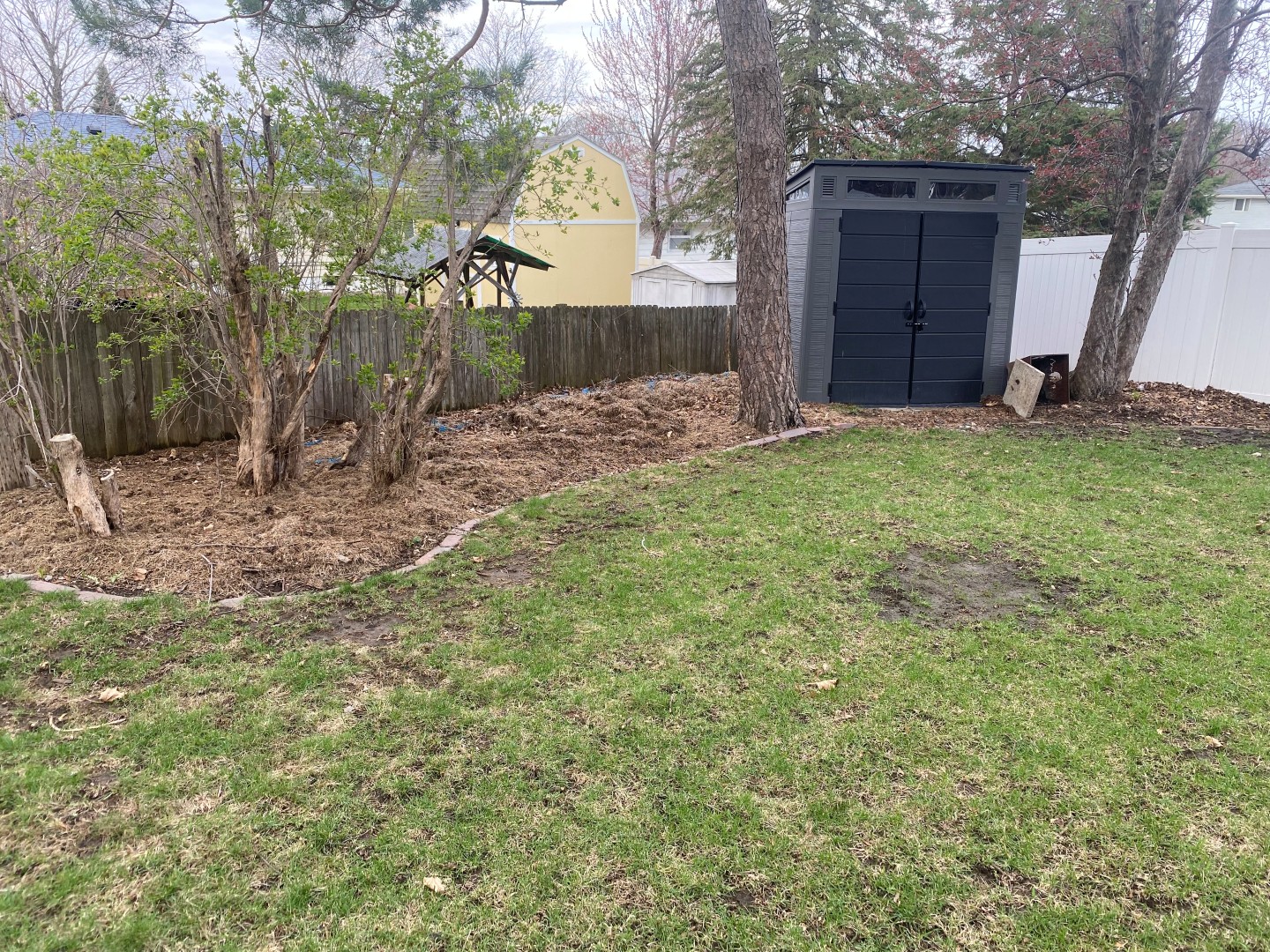
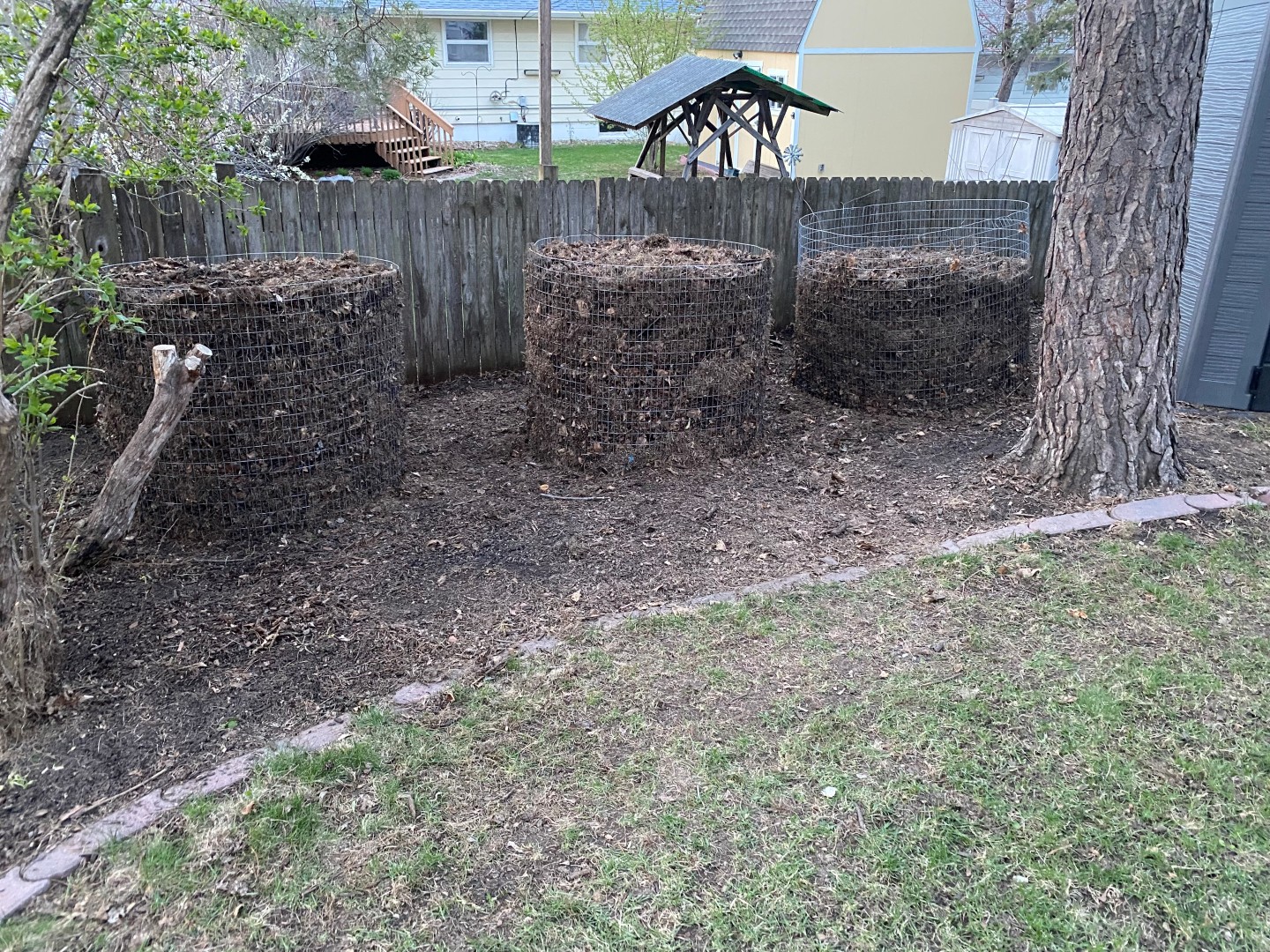
April, 2025
I had dethatched in the spring. This is a collection of that. Each container holds approx. 33 cubic feet or 1.22 cubic yards of compost.
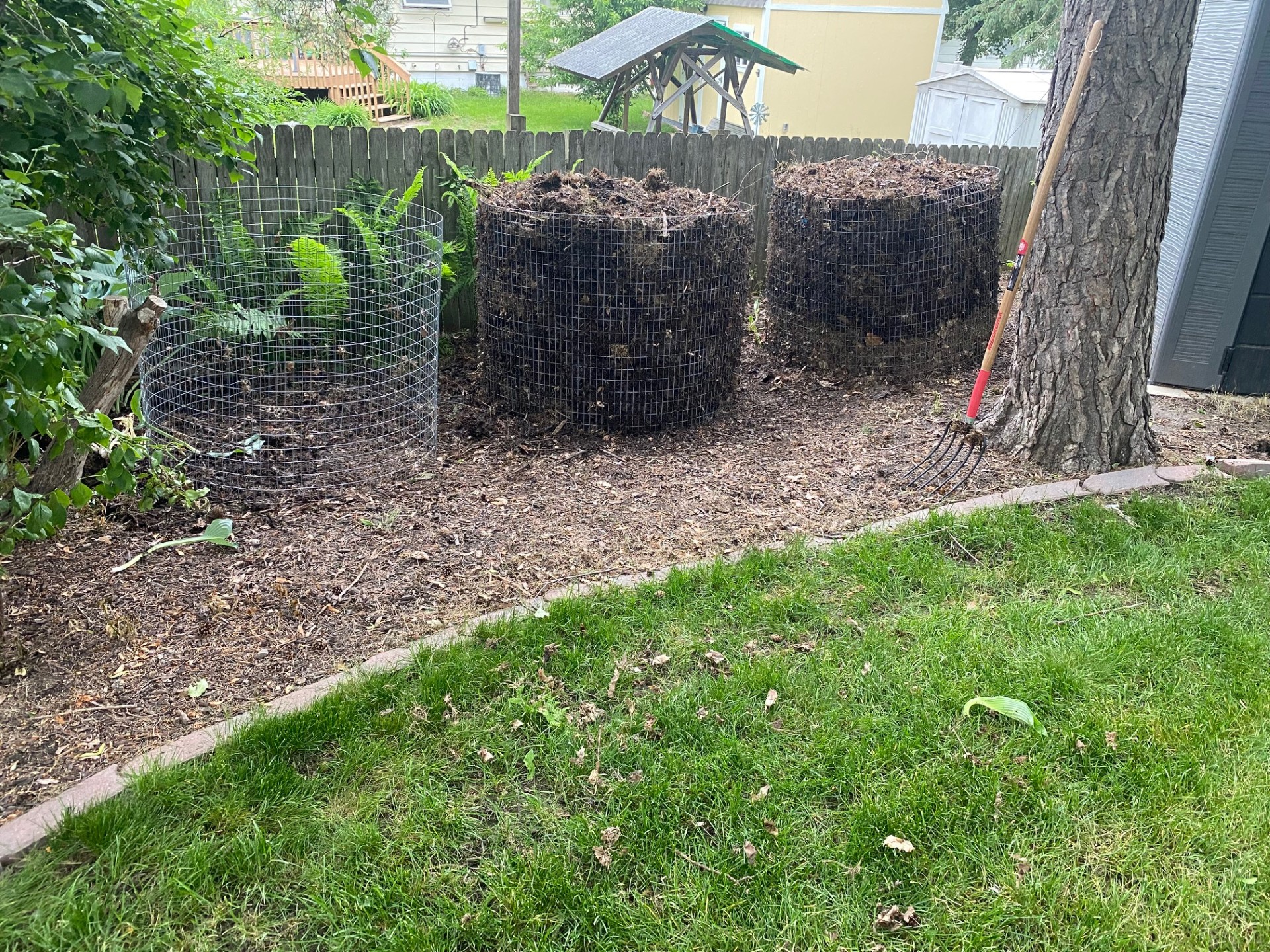
May, 2025
The start – Approx. 2.75 containers full of compostable material. Approx. 3.35 yards of compostable material remains.
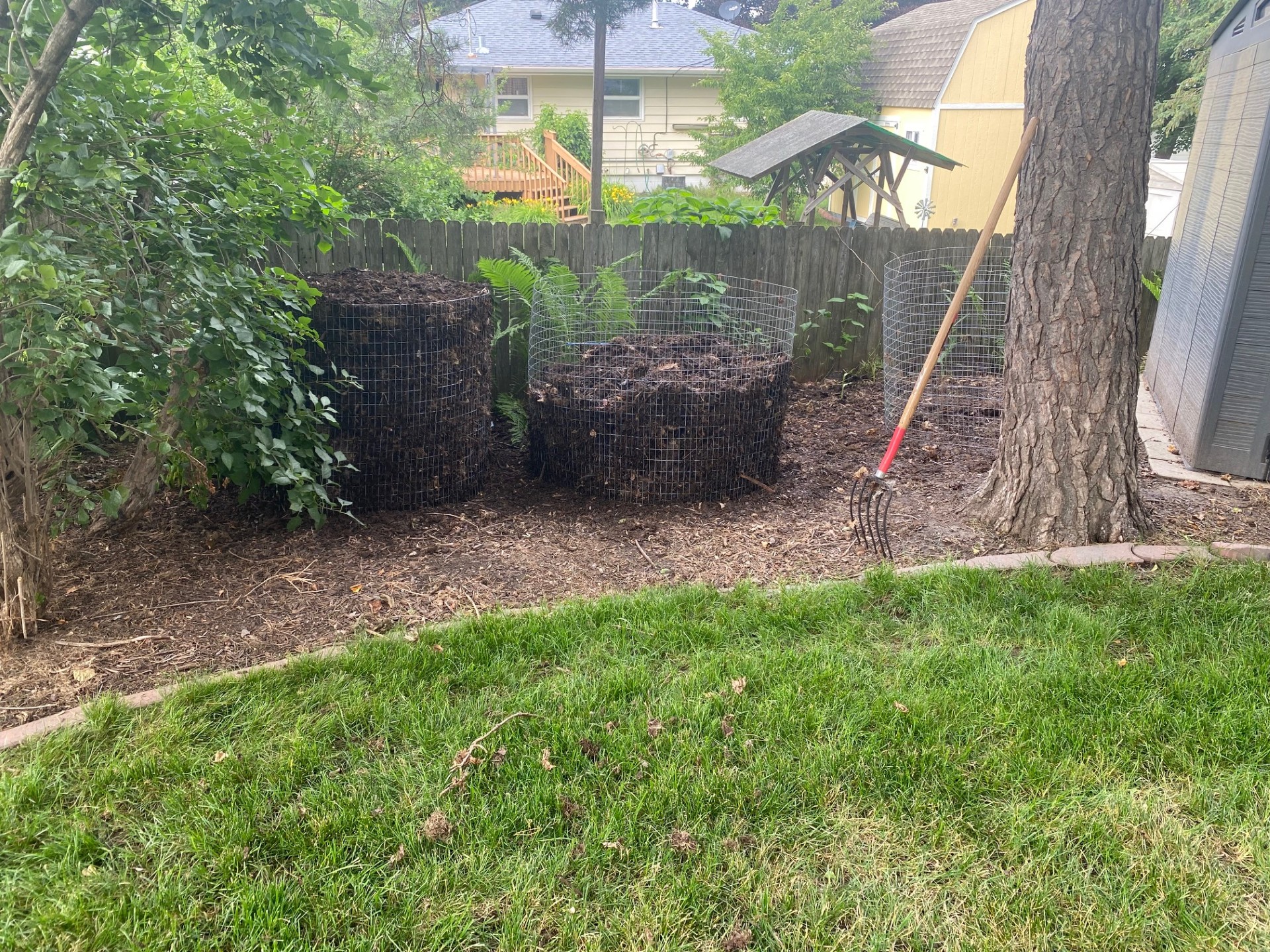
June, 2025
One month in. Turned once. Down to about 2 containers full of compostable material. Approx. 2.44 cubic yards of compostable material remains.
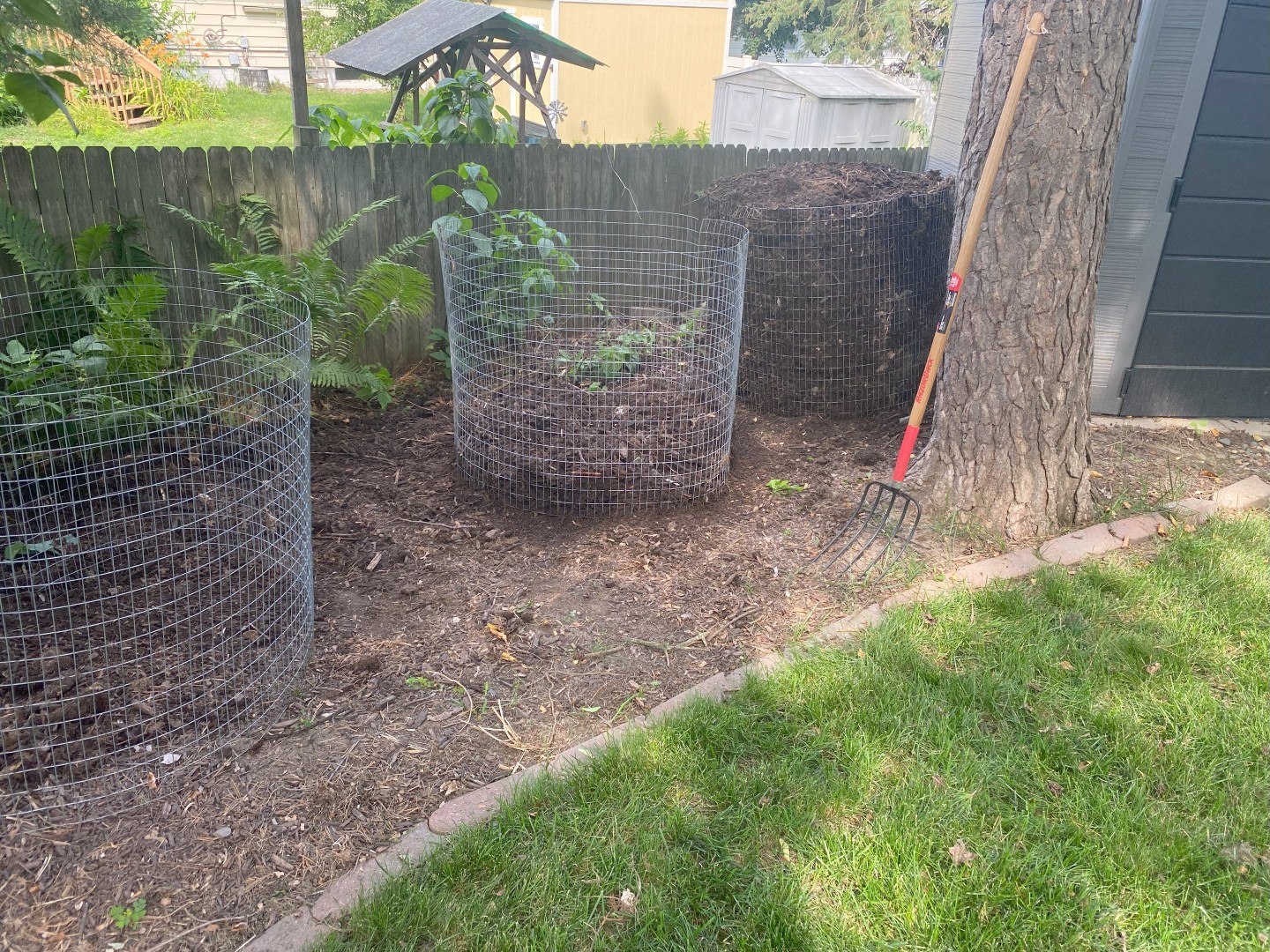
July, 2025
Two months in. Turned twice. Down to about 1.5 containers of compostable material. Approx. 1.83 cubic yards of compostable material remains.
August, 2025
Not as pronounced of a change. The pile wasn’t hot. I think there’s no more “green” left in the stack to continue the biological reactions. We’ll see what next month brings.
Update: At the start of 2025, we scarified our lawn which produced around 3.35 cubic feet worth of compostable material. At the start of 2026, everything had fully composted down to just under 1 cubic feet of compost.